
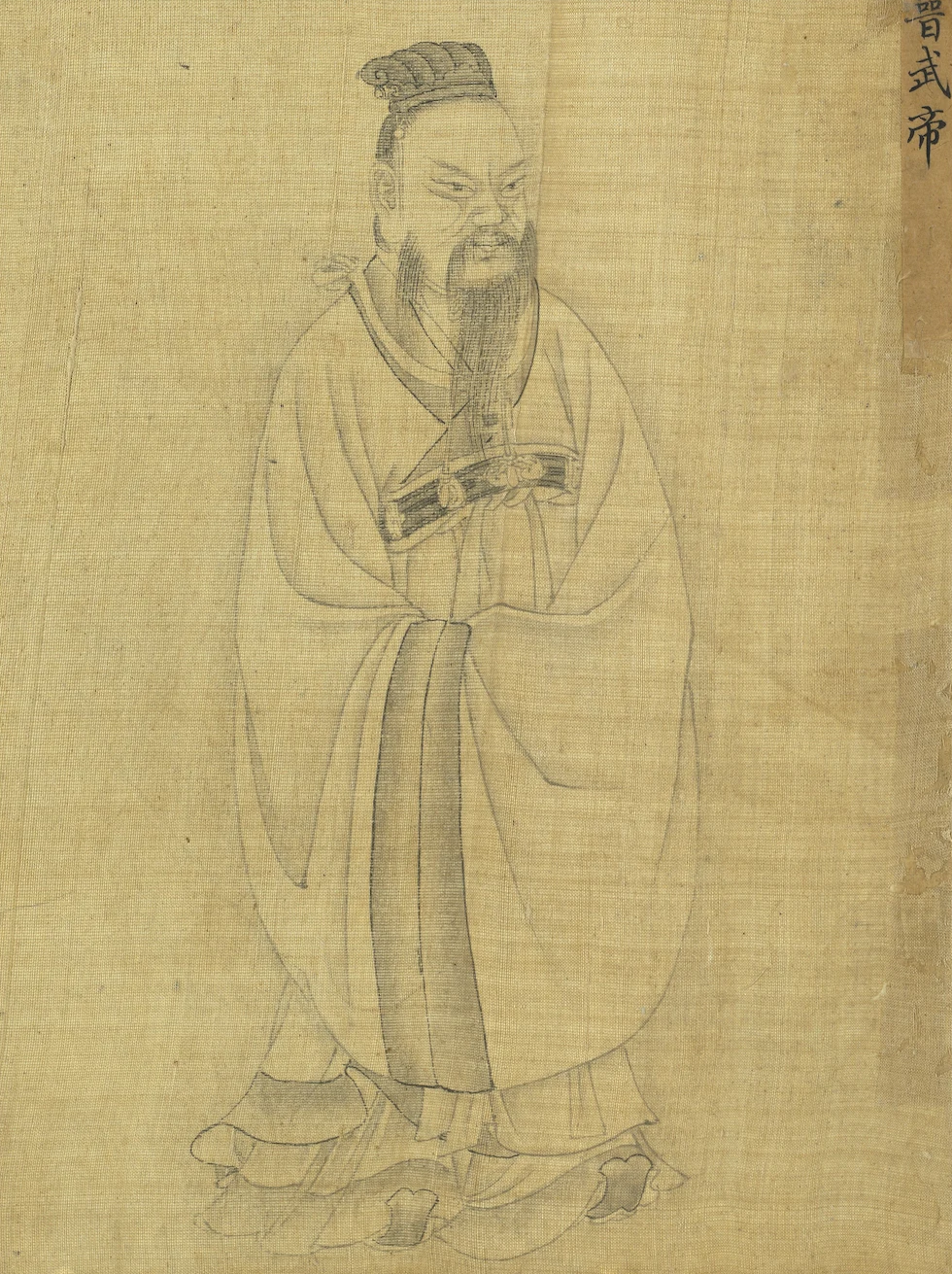
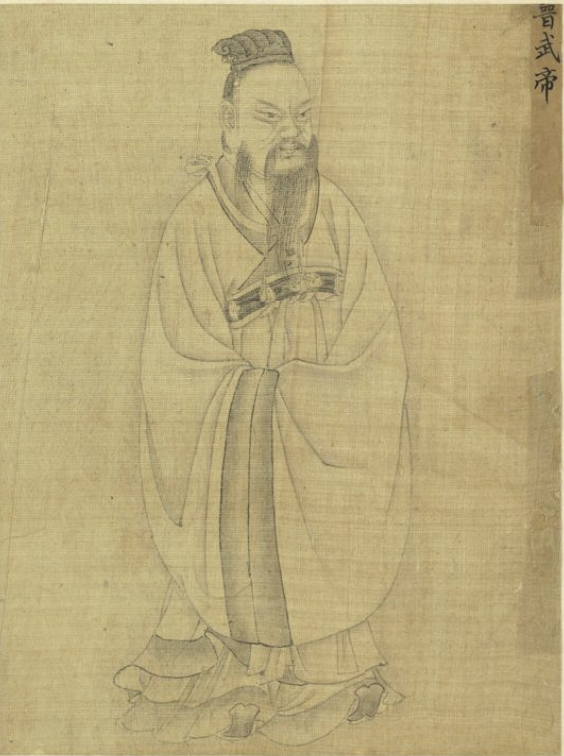
Emperor Wu of Jin

Unknown author · Public domain
His reign is noted for its early stability, but also for the extravagance and corruption that contributed to the dynasty's later collapse.
- field
- Emperor
- nationality
- Chinese (Jin dynasty)
- known_for
- Founding the Jin dynasty, reunifying China, empowering imperial princes, and his extravagance
Lore & Background
As emperor, he immediately empowered imperial princes with independent military commands to avoid what he saw as Cao Wei's weakness. He reformed penal law to be more merciful, but the benefits largely went to nobles, leading to corruption. He faced harassment from Eastern Wu and tribal rebellions in the northwest, but under generals Yang Hu and Wang Jun, he prepared for conquest. Emperor Wu was known for his generosity and kindness, but also for wastefulness. He tolerated noble corruption, which drained resources. His selection of the developmentally disabled Sima Zhong as crown prince and the marriage to Jia Nanfeng contributed to later instability. After his death, the War of the Eight Princes and 'Five Barbarians' uprisings destroyed the Western Jin.
Reader's Guide
Emperor Wu's significance lies in founding the Jin dynasty and briefly reunifying China after the Three Kingdoms period. His policies, however, sowed the seeds of the dynasty's rapid decline. By empowering imperial princes with military authority, he inadvertently created the conditions for the devastating War of the Eight Princes. His tolerance of noble corruption and unequal application of penal reforms weakened the state's finances and morale. The choice of his disabled son Sima Zhong as heir, influenced by Confucian principles, led to a power vacuum and the rise of the ambitious Jia Nanfeng. These factors, combined with the 'Five Barbarians' uprisings, caused the fall of Western Jin and the relocation of the court south of the Huai River. His reign thus illustrates the paradox of a conqueror whose internal policies undermined his own achievement.
Did You Know?
- He was a grandson of Sima Yi, nephew of Sima Shi, and son of Sima Zhao.
- Legends boasted of his incredible potency among ten thousand concubines.
Origins in a Fracturing Dynasty
Sima Ye entered the world in 300 into a house already tearing itself apart. His father, Sima Yan, carried the title of Prince Xiao of Wu, making the boy a grandson of the Jin founding emperor, while his mother was a daughter of the distinguished official Xun Xu. Yet his own bloodline was never the thread that shaped his fate. Before he was born, his uncle Sima Jian—the Prince of Qin and the only full brother of Emperor Hui to reach adulthood—had died in October 291. Sima Ye was subsequently named Jian's heir, receiving the Qin title through an intermediate successor who was himself slain by the usurper Sima Lun. His earliest years were swallowed by the savage infighting later called the War of the Eight Princes, a contest among imperial cousins to seize the regency. By the time he turned seven, Emperor Hui was already dead, his brother Emperor Huai reigned in name only beneath the regency of Sima Yue, and the imperial authority that had once held the empire together had been stripped of nearly all its practical force.
The Fall of Luoyang and a Boy's Flight
On the thirteenth of July, 311, Han-Zhao soldiers broke into Luoyang, and the consequences for the imperial family were devastating. Emperor Huai was seized and taken captive. Sima Ye's father, Prince Yan, his unnamed eldest brother, and his cousin Sima Quan, the crown prince, were all killed in the ensuing chaos. Yet the eleven-year-old Prince Ye slipped through the Han army's grasp and made his way to the county of Mi, in present-day Zhengzhou, Henan. There, two uncles serving as Jin officials, Xun Fan and Xun Zu, pledged their loyalty to him as their leader. Later that year, the general Yan Ding attempted to escort the young prince into the Guanzhong region, hoping to reconstruct a viable central government in the Shaanxi heartland. The march was a catastrophe: most of their supporters and troops deserted the column, including both of the prince's uncles. Still, against all expectation, Yan and the boy reached Guanzhong, where the general Jia Ya received them and, in 312, seized Chang'an, giving the prince a place from which to establish a provisional seat of power.
A Throne Built on Four Wagons
Spring 313 delivered the grim confirmation that the Jin dynasty's northern thread had been severed. Word finally reached Chang'an that Liu Cong, the Han emperor, had put the captive Emperor Huai to death. After a period of official mourning, the young prince ascended the throne as Emperor Min under the era name Jianxing. The reality of his court was almost unbearably bare. Chang'an held fewer than a hundred households. The entire imperial treasury amounted to four wagons. Officials conducted their duties without proper uniforms or the seals that lent their authority legitimacy. Military command was delegated to the generals Qu Yun and Suo Chen. Emperor Min dispatched edicts pleading for reinforcements from Sima Bao, who commanded a considerable force in Qin Province, and from Sima Rui, who controlled vast territory south of the Yangtze. Both acknowledged his sovereignty in words but never moved a single soldier. Only Zhang Gui, governor of Liang Province, sent modest detachments and supplies on a periodic basis. When Han forces launched a surprise assault on Chang'an around the new year of 314, the attack was repelled, but the episode exposed the regime's inability to mount any meaningful defense.
Humiliation, Betrayal, and the Last Breath of Western Jin
In the autumn of 316, the Han general Liu Yao, styled Prince of Zhongshan, launched a decisive offensive against the last Jin stronghold in Guanzhong. After taking Beidi Commandery, the remaining Jin-held cities in the region collapsed one after another. Two relief columns did arrive, but their commanders hesitated to commit against Liu Yao's forces, and the window closed. Chang'an was besieged, and by early December the food stores were exhausted. Emperor Min made the agonizing decision to surrender. He was handed over to Liu Yao and transported to the Han capital at Pingyang, in modern Linfen, Shanxi. Liu Cong initially granted him the title of Marquess of Huai'an, a hollow honor. In early 318, at a banquet, the former emperor was forced to pour drinks and serve as a butler. Former Jin officials present broke down in open weeping at the spectacle. Around the same period, a series of uprisings against Han emerged, each demanding the release of the captive Jin emperor in exchange for Han's crown prince Liu Can. Fearing the political danger, Liu Can urged his father to put Sima Ye to death. Liu Cong agreed, and in February 318, the last emperor of the Western Jin was executed.
Gallery
More in Chinese Emperors And Leaders 1-22
Spotted an error? Know more?
This is a living reference — every entry is fact-audited, and reader corrections feed straight into our audit queue. Suggest an edit · See this site's audit record