
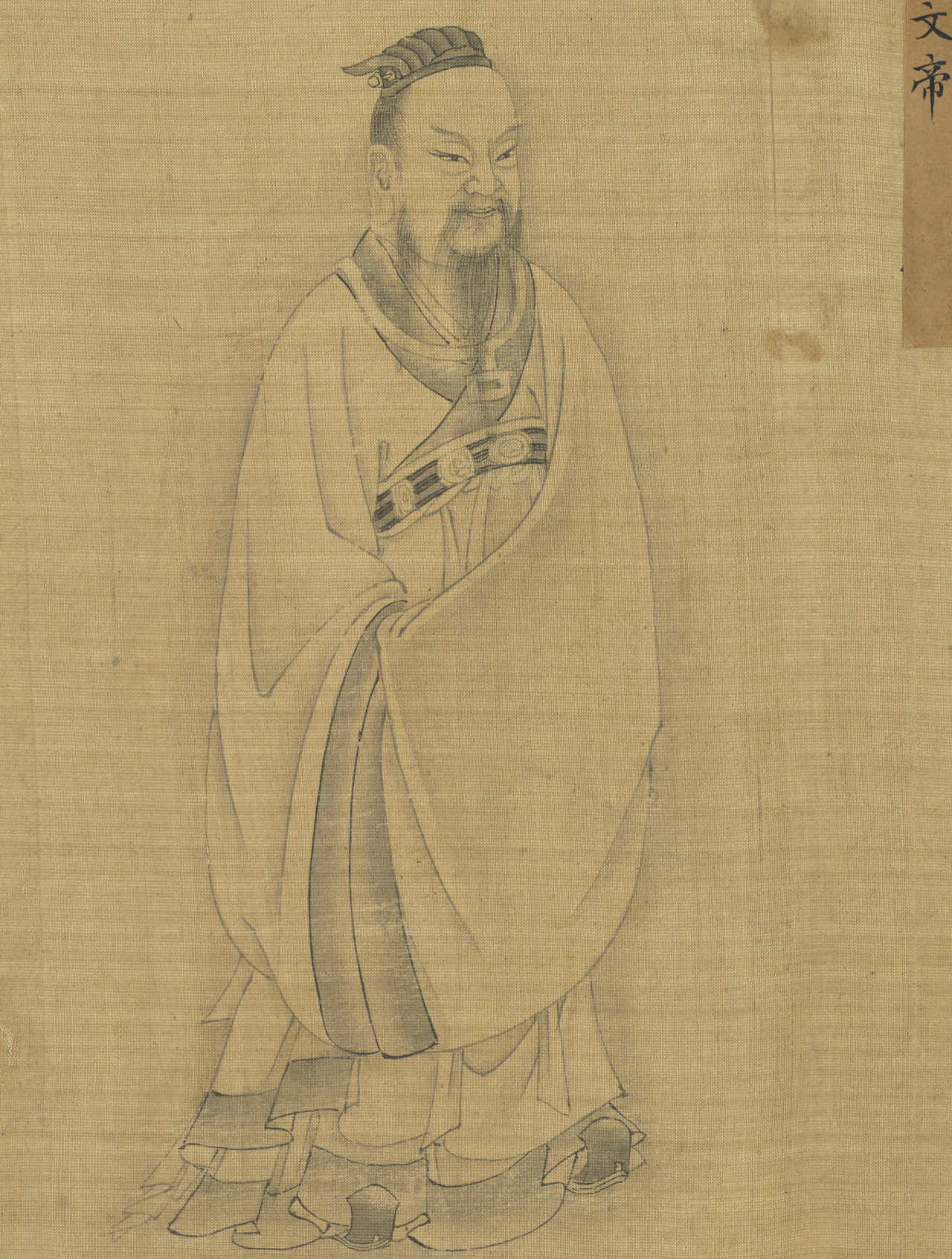
Emperor Wen of Han
Fifth Han emperor who restored stability after Empress Lü's regency.

Unknown author · Public domain
The son of Emperor Gao and Consort Bo, his reign provided stability after the regency of Empress Lü. He was one of only four Western Han emperors to receive a temple name, and his reign, together with that of his son Emperor Jing, is referred to as the Rule of Wen and Jing.
- field
- Monarch
- nationality
- Han dynasty (Chinese)
- known_for
- Rule of Wen and Jing; political stability; low tax rates; Taoist-influenced governance
Reader's Guide
Emperor Wen's significance lies in his role as a stabilizing force after the violent regency of Empress Lü. His reign, along with that of his son Emperor Jing, is historically regarded as the Rule of Wen and Jing, a period of effective governance and economic recovery. He is one of only four Western Han emperors to receive a temple name, indicating his lasting importance. His policies, influenced by Taoist principles of non-interference and thrift, included low property taxes and reduced harsh laws. His diplomatic handling of Nanyue and his willingness to consult ministers contributed to internal peace. However, his reign also saw controversial decisions, such as the arrest of Zhou Bo and the coinage edict that enriched private interests. His legacy provided the foundation for the expansionist policies of his grandson Emperor Wu.
Did You Know?
- Emperor Wen was one of only four Western Han emperors to receive a temple name, along with Emperor Gaozu, Emperor Wu, and Emperor Xuan.
- He declined the prosperous Principality of Zhao, correctly judging that Grand Empress Dowager Lü intended to make her nephew Lü Lu prince.
- Under his reign, tax rates on property were as low as 1.67%, and warehouses became so full of grain that some decayed.
- He abolished the law permitting arrest and imprisonment of criminals' parents, wives, and siblings, except for treason.
Aristocratic Origins and a Temple Birth
Born on 21 July 541 with the personal name Yang Jian, the childhood nickname Naluoyan, and the Xianbei designation Puliuru Jian, the future Sui founding emperor hailed from the Yang clan of Hongnong. That family traced its lineage to the Han dynasty general Yang Zhen, yet centuries of intermarriage with Xianbei nobility had blended the two bloodlines. His father, Yang Zhong, served as a devoted follower of the late-Northern Wei warlord Yuwen Tai and was granted the Xianbei surname Puliuru as a political honor. Yang Jian's mother, Lady Lü, delivered him inside a Buddhist temple in Pingyi, and a nun named Zhixian, struck by the infant's appearance, raised him during his earliest years. He went on to attend the imperial college reserved for noble sons. At fourteen he entered military service under Yuwen Tai, and by 555 he had been awarded the title Duke of Chengji County. In 557, at sixteen, he wed the thirteen-year-old Dugu Qieluo, daughter of the influential Dugu Xin. A defining trait of his later rule was his consistent emphasis on Han Chinese cultural identity, setting him apart from the Xianbei-influenced courts he had previously served.
Surviving Suspicion and Seizing the Throne
Yang Jian's road to power was shadowed by the constant suspicion of his Xianbei overlords. Under Emperor Wu of Northern Zhou, both the Prince of Qi and the general Wang Gui urged the emperor to execute Yang Jian on charges of treason, but Emperor Wu declined. To stay alive, Yang Jian deliberately masked his full abilities. He proved his worth on the battlefield during the 575 campaign and the decisive 576–577 war that shattered Northern Qi. After Emperor Xuan ascended, his distrust deepened to the point where he once threatened to slaughter the entire Yang clan, summoning Yang Jian to the palace with orders to kill him if any trace of fear showed on his face. Yang Jian walked in calm and unshaken, escaping death. In the summer of 581, Emperor Xuan fell gravely ill while preparing a campaign against the Chen dynasty. Two of his associates, Liu Fang and Zheng Yi, who were personal friends of Yang Jian, rushed him to the palace to assume the regency, overriding a rival candidate. After Emperor Xuan's death, an edict in his name named Yang Jian regent. He swiftly abolished the cruel and wasteful policies of his predecessor, demonstrated personal frugality, defeated the resisting General Yuchi Jiong, and ultimately seized the throne, founding the Sui dynasty and becoming the first ethnic Han ruler to command all of North China since the Xianbei conquest.
Reunification and the Seeds of a Unified State
In 589, Yang Jian accomplished what no ruler had managed in almost three hundred years: the reunification of China proper. The era of division he ended had its roots in 304, when the Cheng-Han and Han-Zhao regimes splintered away from the Western Jin, and it had persisted through successive dynasties of competing states. Beyond military conquest, his reign planted the groundwork for long-term integration: the Grand Canal was initiated as a major infrastructure project that would eventually bind northern and southern China into a cohesive economic and political unit. As a devout Buddhist, Yang Jian also channeled state resources into promoting the spread of Buddhism, embedding religious patronage into the machinery of governance. These combined efforts—territorial unification, hydraulic engineering, and religious policy—transformed a fractured landscape into a single sovereign state and set the institutional template that the subsequent Tang dynasty would inherit and expand.
An Age of Surplus and Strategic Dominance
Contemporary and later sources describe the period under Emperor Wen as an era of extraordinary prosperity, a level of national wealth not witnessed since the Han dynasty. Grain reserves were said to be sufficient to feed the population for fifty years, a striking testament to the agricultural abundance of his reign. The military, meanwhile, projected power in every direction. At the start of his rule, the Sui faced the Göktürk confederation to the north, Tibetan tribes to the west, the Korean kingdom of Goguryeo to the northeast, and the southern state of Champa (Linyi) to the south. By the time of his death in 604, the strategic picture had shifted dramatically. The Göktürks had fractured into eastern and western khanates, with the eastern khanate accepting nominal Sui suzerainty. Goguryeo had likewise become a nominal vassal. Champa was defeated in battle and, though not formally annexed, ceased to pose a credible military threat. The combination of economic surplus and military dominance left the Sui state at the apex of its power when Yang Jian died on 13 August 604.
Gallery
More in Chinese Emperors And Leaders 1-22
Spotted an error? Know more?
This is a living reference — every entry is fact-audited, and reader corrections feed straight into our audit queue. Suggest an edit · See this site's audit record