
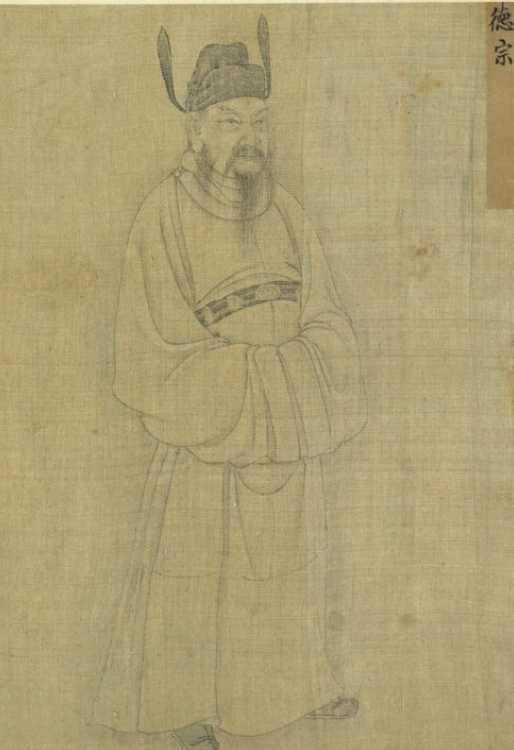
Emperor Dezong of Tang
Emperor whose early reforms gave way to unchecked warlordism.

Gary Todd from Xinzheng, China · CC0
He was the oldest son of Emperor Daizong and reigned for 26 years, the third longest in the Tang dynasty. His reign began with diligent reforms but was marked by failed campaigns against regional warlords, leading to rebellions that nearly destroyed the dynasty, after which he became cautious and allowed warlordism and eunuch power to grow unchecked.
- field
- Emperor
- nationality
- Chinese (Tang dynasty)
- known_for
- Introducing the Law of the Two Taxes; failed campaigns against warlords; rise of eunuch power
Lore & Background
During the Anshi Rebellion, his mother Consort Shen was captured by rebel forces, but Li Kuo was not. He was sent to rendezvous with Tang and Huige forces at Shan Prefecture to recapture Luoyang, but a dispute with the Huige khan led to his aides being beaten and two dying; Li Kuo was unharmed but bore lasting hatred for Huige. After Luoyang was recaptured, he was given the chancellor title Shangshu Ling and his portrait added to the Lingyan Pavilion.
Reader's Guide
Emperor Dezong's significance lies in his contradictory legacy. He began as a diligent and frugal reformer, introducing the Law of the Two Taxes to overhaul finances and reduce burdens on farmers. However, his attempts to destroy powerful regional warlords through military campaigns were mismanaged, triggering rebellions that nearly destroyed the Tang. After these events, he dealt cautiously with regional governors, allowing warlordism to become unchecked, and his trust of eunuchs caused their power to rise greatly. His paranoia about officials' power led him to grant little authority to his chancellors late in his reign. His reign thus marks a turning point where imperial authority weakened, setting the stage for later Tang decline.
Did You Know?
- Emperor Dezong's reign of 26 years was the third longest in the Tang dynasty.
- He introduced the Law of the Two Taxes to reform governmental finances.
- His mother Consort Shen was captured during the Anshi Rebellion and never found, despite several imposters claiming to be her.
- A dispute with the Huige khan during the Luoyang campaign resulted in two of his aides being beaten to death.
Youth in Turmoil and the Huige Humiliation
Li Kuo was born in 742 at the eastern palace in Chang'an, the eldest son of Prince Li Chu. The Anshi Rebellion of 755 shattered the court's stability—his great-grandfather Emperor Xuanzong fled to Chengdu while Li Kuo's father and the imperial family retreated to Lingwu. His mother, Consort Shen, was captured by rebel Yan forces, though Li Kuo himself was not taken. After Chang'an's recapture in 756 and his father's elevation to emperor in 762, Li Kuo received the supreme military commander title and was dispatched to coordinate with allied Huige forces at Shan Prefecture for the campaign to retake Luoyang. There, he treated the Huige Dengli Khan Yaoluoge Yidijian as an equal—a gesture that enraged the Khan. Yaoluoge had four of Li Kuo's subordinates arrested and whipped brutally; two of them, Wei Ju and Wei Shaohua, died that very night. Li Kuo himself was spared but sent back. This humiliation planted a deep-seated animosity toward the Huige that would color his later foreign policy decisions.
The Reformist Opening
Within months of ascending the throne in 779, Emperor Dezong made a decisive break from his father's court. Chancellor Chang Gun, whom he viewed as dangerously influential, was exiled and replaced. The legendary general Guo Ziyi, whose military authority dwarfed the throne, was effectively pushed into retirement with his commands split among three lesser generals. In a symbolic gesture of frugality, Dezong released the imperial menagerie's animals, dismissed numerous palace ladies, and banned eunuchs serving as messengers from accepting gifts. He also detained Cui Ning, the long-serving military governor of Xichuan Circuit who had governed for over a decade under only nominal imperial obedience, and reasserted direct control over the region. Perhaps most significantly, at the suggestion of chancellor Yang Yan, Dezong introduced the Law of the Two Taxes, a sweeping fiscal reform designed to lighten the burden on landholders and farmers while finally bringing merchants into the tax net. These early moves painted the portrait of a determined, hands-on ruler intent on centralizing power and fixing the dynasty's finances.
The Warlord Backlash
Dezong's most ambitious project—systematically dismantling the powerful regional warlords—backfired catastrophically. His campaigns against the Jiedushi military governors were poorly managed, and the resulting rebellions threatened to tear the Tang dynasty apart. The near-collapse of imperial authority during these uprisings was a defining trauma of his reign. In the aftermath, Dezong's posture shifted dramatically. Rather than pressing further military action against the regional governors, he adopted a cautious, conciliatory approach that effectively allowed warlordism to persist unchecked. The energy and will that had driven his early reformist phase seemed to drain away. What remained was a ruler who had gambled the dynasty's stability on a single strategy, lost, and then retreated into a passive accommodation with the very forces he had sought to eliminate. The warlord problem that had plagued the Tang since the Anshi Rebellion thus continued to erode central authority for the remainder of his 26-year reign.
Paranoia and the Eunuch Problem
In his later years, Emperor Dezong's governance was shaped by a deep suspicion of powerful officials. He grew increasingly reluctant to grant his chancellors meaningful authority, preferring to keep decision-making tightly in his own hands. This paranoia, however, created a vacuum that eunuchs filled. Dezong's personal trust in his eunuch attendants allowed their influence to expand enormously, setting a dangerous precedent for the rest of the Tang dynasty. The irony was stark: a ruler who had begun his reign by banning eunuchs from accepting gifts and who had spent his early years curbing the power of generals and chancellors ultimately empowered the very class of court insiders he had initially sought to restrain. His 26-year reign—the third longest in Tang history—thus ended with the central government's authority weakened on two fronts: the regional warlords remained autonomous, and the eunuch faction had grown into a formidable political force. The structural imbalances he left behind would haunt his successors.
Gallery
More in Chinese Emperors And Leaders 1-22
Spotted an error? Know more?
This is a living reference — every entry is fact-audited, and reader corrections feed straight into our audit queue. Suggest an edit · See this site's audit record