
Duke Mu of Qin
Duke of Qin, sometimes counted among the Five Hegemons.

Gary Todd from Xinzheng, China · CC0
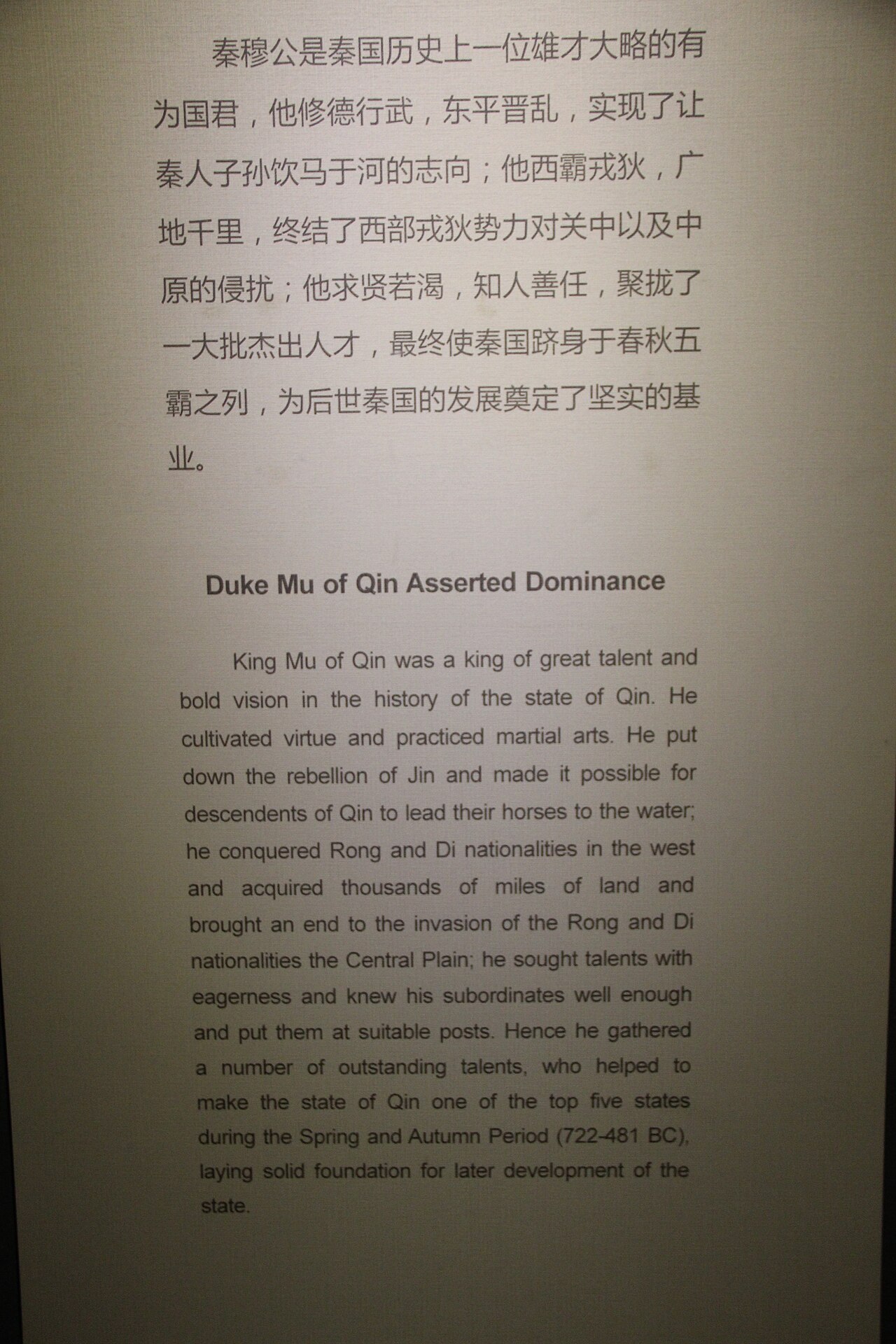
He is sometimes considered one of the Five Hegemons, known for greatly expanding Qin's territory under King Xiang of Zhou and for his many talented advisors, including Baili Xi, Jian Shu, Pi Bao, and Gong Sun.
- born
- Ying Renhao
- field
- Ruler, military leader
- nationality
- State of Qin (ancient China)
- known_for
- Expansion of Qin, Five Hegemons, Friendship of Qin and Jin
Lore & Background
Duke Mu was the son of Duke De of Qin and younger brother of Duke Cheng. He married Mu Ji, daughter of Duke Xian of Jin, and married his daughter Huai Ying to two of Duke Xian's sons. These marriages led to the saying 'the Friendship of Qin and Jin,' denoting political alliances based on marital bonds. He is also noted as the master of Bole, a famous horse expert. During his early reign, Jin was powerful under Duke Xian but fell into internal conflict after his death. Duke Mu aided Jin during a famine, but when Qin later suffered famine, Jin attacked instead of repaying the aid. After several battles, Duke Mu helped establish Chong'er (Duke Wen of Jin) on the Jin throne, improving relations. With his eastern front stable, Qin campaigned against western tribes, and with the services of You Yu, Duke Mu got eight barbarian tribes to submit. The Qin army was ambushed by Jin at the Battle of Yao and suffered heavy casualties. Three years later, Qin won a major revenge victory, but Duke Mu refused to advance further east after holding a funeral for those killed at Yao, focusing instead on expanding Qin's western borders.
Reader's Guide
Duke Mu of Qin is significant for his role in expanding Qin's territory and for his diplomatic and military strategies that earned him a place among the Five Hegemons of the Spring and Autumn period. His handling of relations with the state of Jin, including the famous 'Friendship of Qin and Jin' political marriages, stabilized his eastern front and allowed him to focus on conquering western barbarian tribes. His achievements in the western campaigns and his foreign relations with Jin are the basis for his hegemonic status. Duke Mu's legacy includes his patronage of talented advisors and his association with the horse expert Bole, whose skills became iconic in folklore and idioms. The uncertainty over the names of his daughters (Huai Ying and Wen Ying possibly being the same person) reflects the complexities of historical records from this period.
Did You Know?
- Duke Mu's posthumous title 'Mugong' means 'Solemn Duke of Qin' and was bestowed by his successors.
- He is noted as the master of Bole, a famous horse expert whose skills became iconic in folklore and idioms.
- His marriages led to the saying 'the Friendship of Qin and Jin,' used to denote political alliances based on marital bonds.
- After the Battle of Yao, Duke Mu held a funeral service for those killed and refused to advance further east.
Roots in the Western Marches
The state that Duke Mu would later command traces its lineage to the legendary Five Emperors, specifically Zhuanxu. One of his descendants, Boyi, received the family name Ying from Emperor Shun. During the Xia and Shang periods, this clan divided into two: a western branch that migrated across the Ordos Plateau to a settlement called Quanqiu, and an eastern branch that settled in what is now Shanxi and became the ancestors of the Zhao rulers. The western branch served as a buffer against the Xirong nomads on behalf of the Shang dynasty. A defining moment arrived when Feizi, a younger son of a Shang-era lord, demonstrated exceptional horse-breeding skill before King Xiao of Zhou. Impressed, the king granted him a separate fief in the Qin valley of modern Gansu and named his seat Qinyi. This horse-breeder ancestor became the founding figure of the Qin line, and modern scholars have noted that this connection to equine husbandry may hint at partial nomadic heritage among the Ying family, a thread that would echo through generations of Qin identity.
Blood, Sacrifice, and the Rong Threat
The early Qin line was shaped by relentless conflict with the Xirong. In 842 BC, a noble revolt against the corrupt King Li of Zhou plunged the realm into chaos, and the Rong seized the opening to attack and exterminate the senior Ying branch at Quanqiu. Only the cadet line at Qinyi survived. When King Xuan of Zhou ascended in 827 BC, he placed Qin Zhong, Feizi's great-grandson, in command of forces against the Rong. Qin Zhong fell in battle in 822 BC, and his son Duke Zhuang inherited the struggle. In recognition of Qin Zhong's loyalty, King Xuan granted the Qin brothers 7,000 soldiers, and they defeated the Rong and reclaimed their lost ancestral lands. Duke Zhuang's eldest son Shifu later turned down the succession to continue fighting the Rong, while his brother Duke Xiang arranged a marriage alliance with a Rong king in a bid for peace. This cycle of warfare, personal sacrifice, and desperate diplomacy forged the martial character of the state for generations to come.
The Barbarian Stigma and the Huaxia Assertion
The Central Plains states looked down on Qin, Yan, and Chu as culturally inferior because of their peripheral positions. A Wei noble as late as 266 BC still remarked that Qin shared customs with the Rong and Beidi tribes. The Ying clan had lived amid Rong territories for generations, sometimes clashing with their armies and sometimes intermarrying with their kings. After the Zhou collapse, Qin absorbed cultural elements from both the Rong and Beidi, deepening the perception of otherness among its rivals. Yet the state was acutely sensitive to this discrimination and worked deliberately to assert its Huaxia identity. Qin law classified mixed-ethnicity offspring as Huaxia, and the state showed a marked preference for recruiting soldiers from the neighboring state of Jin rather than relying solely on local populations. Qin was also the second state after Zhao to adopt nomadic cavalry tactics, blending foreign military innovation with a determined effort to be recognized as a legitimate Chinese power rather than a frontier curiosity.
Elevation and the Royal Promise of the West
The transformation of Qin from a minor attached state into a full autonomous vassal came through Duke Xiang's service to the Zhou court. In 771 BC, the Marquess of Shen, the state of Zeng, and the Quanrong nomads jointly sacked the Zhou capital at Haojing, killing King You and ending the Western Zhou dynasty. Duke Xiang led his troops to escort the young King Ping to Luoyi, where the Eastern Zhou capital was established. In gratitude, King Ping formally enfeoffed Duke Xiang as a feudal lord, elevating Qin from a fuyong—a minor state with limited self-rule under another lord's authority—to a major vassal with full autonomy. King Ping further promised to permanently grant Qin all lands west of Qishan, the former Zhou heartland, provided the state could expel the Rong occupying it. This royal promise became a driving force for successive Qin rulers, who launched repeated campaigns against the Rong and expanded their territory far beyond the original ancestral lands, eventually viewing the Zhou kings Wen and Wu as their own predecessors.
Gallery
More in Chinese Emperors And Leaders 1-22
Spotted an error? Know more?
This is a living reference — every entry is fact-audited, and reader corrections feed straight into our audit queue. Suggest an edit · See this site's audit record